Naos and Dome
Depicted opposite the tombs, on the west wall of the naos, is an enormous Tree of Jesse, a complex presentation encompassing the Old and New Testaments.The starting point for this presentation is the well-known verse in the prophecy of Isaiah regarding Christ as a shoot from the stump of Jesse, the father of King David, whose descendant was to be the Most Holy Theotokos. The Dečani Tree of Jesse is the most comprehensive and complete in Byzantine painting, comprised of the images of a large number of Christ’s predecessors in body, as well as events from the Old and New Testaments and the prophets who foretold these events. In the highest reaches of same part of the church there are several other scenes from the Old Testament which announce future events and the coming of the Savior: the story of Solomon’s wisdom and scenes from the Book of the prophet Daniel.
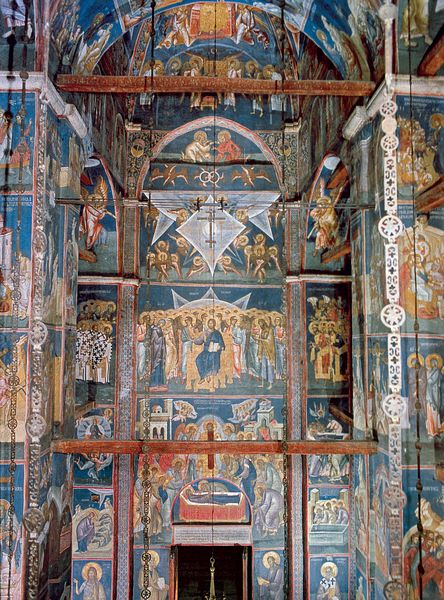
Crossing from the south to the north chapel through the western part of the naos, we can see scenes from the Second Coming of Christ on the vault, the wall and the pillars. The sequence of events begins at the highest point of the vault with His descent from Heaven on a throne lowered by two angels. Instead of Christ the Final Judge, we see Christ the Pantocrator with an almost meek expression depicted in Dečani as He addresses the blessed with words from the open Gospel on His knee and motions with His hand that they are to receive the Kingdom of Heaven. In addition to angels, twelve separate scenes depict choruses of the righteous, the supplicants of humankind before Christ with their hands raised in prayer: apostles, martyrs, saints, bishops, monks, prophets, and the righteous of the Old Testament.
Pictures of Heaven: The Theotokos on the throne, the repentant thief with the cross, the righteous in the embrace of Abraham and others, are painted on the pillars opposite the west wall. Below the scenes of Heaven on the pillars the fate of those suffering the tortures of hell is shown.
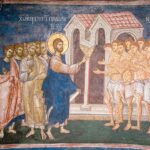
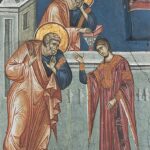
The cycle of frescoes about Christ’s disciples is located in the northwestern part of the Dečani naos as far as the north chapel. This cycle is relatively rare in Byzantine and Western churches, and in many respects is a unique phenomenon in the art of this period. Twenty scenes following the order of events presented in the Acts of Apostles, starting from the vault and gradually descending to the surrounding walls and pillars, tell the history of the miracles, missionary activity and martyrdom of Apostles Peter and John, Philip, Paul and St. Stephen the Protomartyr.
The area in the central part of the naos under the cupola is distinguished by its beauty and the geometric arrangement of its marble floor tiles. An ambo rosetta of polished onyx and breccia is inset in a square area. The diagonally arranged pattern in it was hollowed out and filled with lead, and then covered with golden tiles.
Monumental figures of the prophets with highly characteristic, powerful physiognomies are arranged below the Pantocrator, who is surrounded by an illustration of the Heavenly Liturgy.
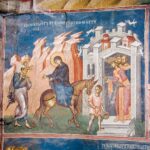
In the zones under the cupola are the magnificent compositions of the feast days of Christ and the Theotokos, which have been almost perfectly preserved. The great feast days are arranged in the order of their occurrence on the walls under the cupola and the arched surfaces below them.
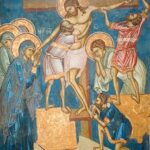
The cycle of Christ’s sufferings is depicted in detail in the higher parts of the naos. It begins on the arch in the western part of the church with the Last Supper, stretching across the pillars that hold up the cupola and finishes in the vault of the altar section.
On the right and left side of the naos under the cupola are the choir areas, which the parapet walls separate from the chapel and the western part of naos. In the right choir area is an elaborate, marble king’s throne, similar to Western European royal thrones, with a raised back and slightly arched sides ending in armrests ornamented with rosettes.
The illustration of the Church, as the community of God and humankind, all the saints – from the oldest to the newly recognized – and the living, is most completely and visibly demonstrated on the lowest painted belt of the Dečani church. At almost the same height and of the same size as the people in the church, these individual and forward facing figures of the saints were painted very carefully and with a wealth of gold. Most are holy warriors but there are also hermits, non-mercenary physicians and Serbian saints; many of them are shown giving a blessing or teaching by means of words written on their scrolls.